
• We've upgraded and reskinned the forum. Notice something off? Email us at [email protected] and we'll fix it.

V1 Ignition switch "kill" wiring (5V reference and 12V woes)

duthehustle93

Well-Known Member
duthehustle93
Hi All,

I'm wiring in a 6 pole kill switch now, and I need to find a circuit that I can open to turn off the car. I'm installing the kill switch next to the ignition switch so an obvious choice would be to kill one of the ignition switch wires, but I'm really struggling with this complicated ignition switch. I read through @ctuinstra push button thread twice and I can't figure it which singular wire I can open to kill the car. VATS hasn't been disabled and I don't plan to... maybe I can use that to my advantage?

I know the following:
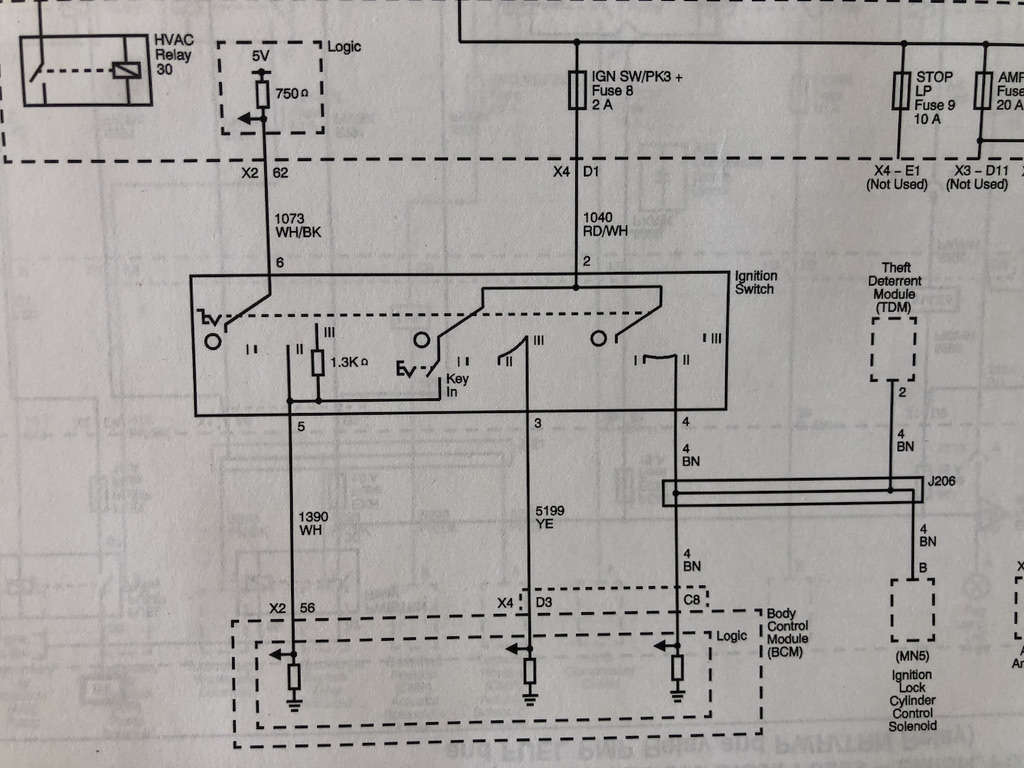
pin 1: not used
pin 2: red/white: 12V constant
pin 3: yellow: receives 12V from pin 2 when ignition switch is in 2nd position
pin 4: brown: receives 12V from pin 2 when ignition switch is in 1st or 2nd position.
pin 5: white: 12V from pin 2 when key is in, 0V/open in 1st position, switches to and pulls down 5V reference voltage (from pin 6) across the theft resistor in 2nd position
pin 6: white/black: reference 5V

So... the reasonable conclusion I came to was open pin 2 to open ignition. I cut the red/white (pin 2) wire, and the ignition switch cycles through perfectly like nothing happened, I can even start and run the car! My next reasonable conclusion was to reconnect the red/white wire I cut, and use the white/black (pin 6) wire... I cut that one... and same thing! Ignition switch cycles perfectly and I can even start the car! I can start the car, and open either of these with no ignition kill. I must open both pin 2 and pin 6 in order to kill the car. I only have 1 available pole on my kill switch, and obviously I can't combine 12V and 5V on a single switch. I would really prefer to keep my kill switch simple and not have a secondary relay or a voltage converter, it can't be that complicated, right?

Is there a single wire on the ignition switch or VATS that I can open to turn off the car? Alternatively, is there anything wrong with leaving my 5V white/black (pin 6) wire severed, and I can switch red/white (pin 2)? Everything seems "fine" with the latter route, but purposely severing a circuit that (probably) has a purpose feels like the wrong way to do this.
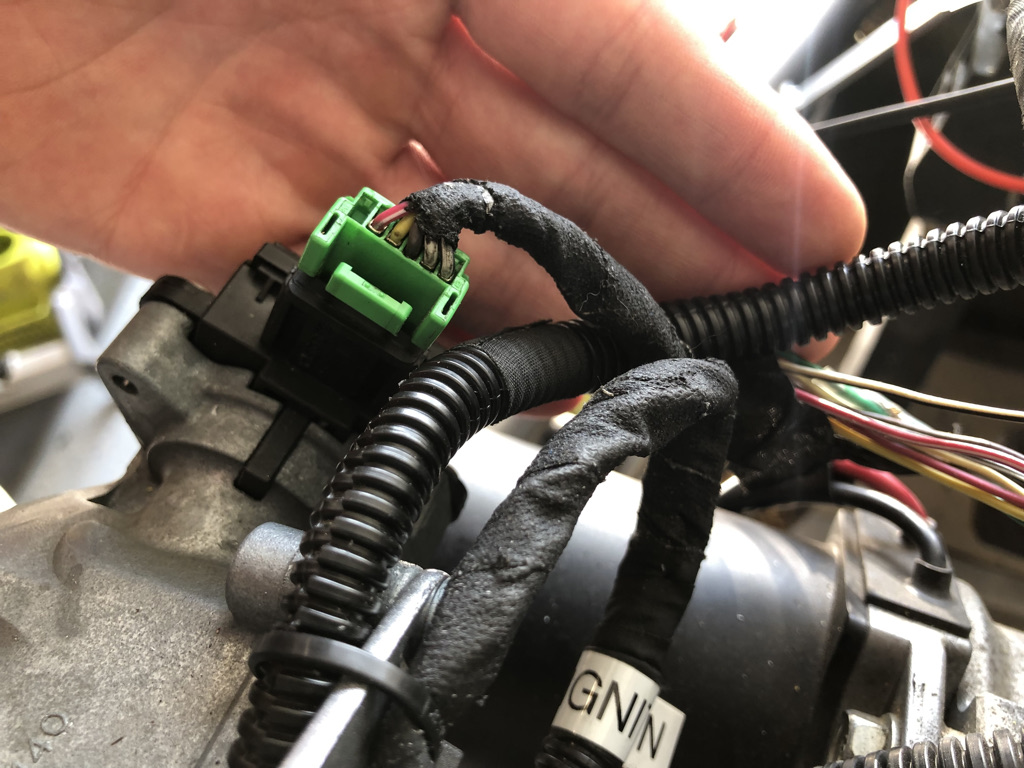
53225


53226
 
Last edited:
Rauq
Are you doing this for antitheft purposes or power kill for track-related incidents? Because there's different answers to each.
 
ctuinstra
How are you wiring a 6-pole switch to do everything? You would need a multi-throw switch. It can't be on/off. There is a start circuit that is only temporarily engaged. Maybe I'm missing something here.

If you cut the 5V reference on the WH/BK wire, it will never give the reference voltage via the 1.3K resistor to crank. If it's still cranking with that wire disconnected, I have no idea how, that literally provides the signal to command a crank/start.

I would assume opening Pin 5 (WH) would effectively kill the engine, however, there isn't enough information available in the manuals to determine the inner logic the BCM to know for sure.

On my push-to-start system, multiple relays open in order to completely kill the ignition.

I don't think only one wire is going to kill everything in a safe manner short of disconnecting the battery (as far as for safe storage).
 
G
Assuming you have a switch like this Battery 6-Pole Kill Switch and are killing the battery and alternator similar to what sketch, I would probably break X4 D1, circuit 1040. That will kill the car. I'm not real sure how necessary it is to do anything beyond disconnecting battery and alternator though. But I would probably leave any "logic" circuit alone.

Or you could intercept hot wire to the coils and ignore the ignition switch. Or you could follow D.S. suggestion of cutting power to the fuel pump. What exactly are you trying to "protect" with the ignition disconnect that the battery/alternator kill doesn't accomplish?
 
duthehustle93
How are you wiring a 6-pole switch to do everything? You would need a multi-throw switch. It can't be on/off. There is a start circuit that is only temporarily engaged. Maybe I'm missing something here.

If you cut the 5V reference on the WH/BK wire, it will never give the reference voltage via the 1.3K resistor to crank. If it's still cranking with that wire disconnected, I have no idea how, that literally provides the signal to command a crank/start.

I would assume opening Pin 5 (WH) would effectively kill the engine, however, there isn't enough information available in the manuals to determine the inner logic the BCM to know for sure.

On my push-to-start system, multiple relays open in order to completely kill the ignition.

I don't think only one wire is going to kill everything in a safe manner short of disconnecting the battery (as far as for safe storage).
Thanks for the reply! As well as thoroughly posting your prior work.

To clarify: I am using the original key and have no plans of doing a push start... I was just referencing your research because it has a wealth of knowledge about how this ignition switch works. This is a 6 pole FIA kill switch (the one I am using is off a retired race car, but I believe it's an OMP one). I left out the details for the kill switch because I didn't want to muddy up the thread, but here is how they are conventionally wired:

53239


The main (large) posts are N.O., Z is N.O., and W is N.C. The principle is that when you turn off the kill switch the main posts disconnect the battery from the vehicle, Z interrupts a circuit that immediately turns off the car, and W provides a path to ground for any residual electrons to avoid frying sensitive modules.

I've installed dozens of these (but only in cars that were built in the 90's) and usually you can put 'Z' in line with the ignition switch which basically mimics you turning off the ignition key.

And to confirm: yes, with red/white (pin 2) cut, acc, ign/run, and start all work. If I add a switch to red/white, opening it once the car is started does not shut off the car. I tried the same exact thing with white/black (pin 6), with the same results. I would imagine that redundant anti-theft circuits would be an 'and' not an 'or' for functionality.

Is there a reason why pin 5 (white) may be more affective than pin 6 (white/black)? I've already tried pin 6 with no luck, which feeds pin 5 from what I can tell. I might give it a try when I get home but I'm trying to avoid hacking up this harness any more than I need to.

Thank you for confirming that you use multiple relays to kill ignition... based off your diagram here I was assuming that opening pin 2 (red/white) would be enough to kill ignition.

Regarding disconnecting the battery, most cars from what I've seen will continue running off alternator power, which can also fry things as the alternator surges once you remove the load (battery). This is why 4 pole kill switches exist (2 poles are used for battery, 2 for a "kill"). I prefer 6 poles because the additional two poles provide a safe pull down path to ground.
 
duthehustle93
Assuming you have a switch like this Battery 6-Pole Kill Switch and are killing the battery and alternator similar to what sketch, I would probably break X4 D1, circuit 1040. That will kill the car. I'm not real sure how necessary it is to do anything beyond disconnecting battery and alternator though. But I would probably leave any "logic" circuit alone.

Or you could intercept hot wire to the coils and ignore the ignition switch. Or you could follow D.S. suggestion of cutting power to the fuel pump. What exactly are you trying to "protect" with the ignition disconnect that the battery/alternator kill doesn't accomplish?
Unless you rewire so that the alternator is on the battery side of the kill switch, you must have a separate pole that kills the vehicle. Separating the battery does not reliably turn off a car, as the alternator on a running vehicle is a power source in itself that will keep the vehicle alive, which keeps the alternator excited. Sometimes it'll work, but not reliably enough for tech or to be used a safety device. The amount of batteries I replaced while keeping the car running when I worked at a shop in high school and didn't know any better and didn't want to deal with radio codes was proof of this.

I 100% agree that circuit 1040 should kill the car, but that was the first thing I tried and it didn't do anything:
So... the reasonable conclusion I came to was open pin 2 to open ignition. I cut the red/white (pin 2) wire, and the ignition switch cycles through perfectly like nothing happened, I can even start and run the car!

Unfortunately I already have my wiring harness and tunnel cap all wrapped up, which is why I'm a bit hellbent on using the ignition switch rather than running more wires down the length of the car. Pulling some wires down the tunnel for ignition kill at the back of the car is an option that I might have to go with at this rate, but my kill switch is mounted right next to the ignition switch, so it'd be MUCH cleaner to be able to use that for kill. It's not a hill I need to die on, but it seems crazy that there isn't a wire on the ignition switch that would emulate a key-off. You can't use fuel pump because the car will sputter on residual fuel pressure... rules and tech always require an immediate kill @ >3000RPM. I'm not sure if I follow you on your "protect" question... one pole set separates the power source from the vehicle, one pole set kills the vehicle, one pole set provides a path to ground on the vehicle side. I've wired 4 pole switches, which just have a battery disconnect+ignition kill, but I've recently started using 6 poles as other teams that I know have started having issues with 4 poles on newer cars w/ more sensitive electronics.
 
Last edited:
ctuinstra
Thanks for the reply! As well as thoroughly posting your prior work.

To clarify: I am using the original key and have no plans of doing a push start... I was just referencing your research because it has a wealth of knowledge about how this ignition switch works. This is a 6 pole FIA kill switch (the one I am using is off a retired race car, but I believe it's an OMP one). I left out the details for the kill switch because I didn't want to muddy up the thread, but here is how they are conventionally wired:

View attachment 53239
That makes much more sense. I was not aware of that type of switch. In general electronics, switches are described by the throws and poles. So a DTDP (Dual Throw and Dual Pole) would have only six connection points - two separate switches with common, Normally Open, and Normally Closed) and that's what I was thinking of. Yours is more like a six post.
 
duthehustle93
That makes much more sense. I was not aware of that type of switch. In general electronics, switches are described by the throws and poles. So a DTDP (Dual Throw and Dual Pole) would have only six connection points - two separate switches with common, Normally Open, and Normally Closed) and that's what I was thinking of. Yours is more like a six post.
Oops... my background is mechanical and automotive and I feel like we're incredible at getting electrical terms right enough to make sense to most, but wrong enough to confuse people who know what they're doing lol. Thanks for the information!

I guess to ultimately drill this down to my main question... considering what I'm doing, do you know of any single wire at the ignition switch, VATS, or even near the steering wheel and instrument cluster that would reliably shut off the car if severed? This is the first time I've seen an ignition system that didn't have a single wire that could emulate "ignition off" ... I've already loomed and tidied up my harness with the assumption that I could do my kill switch at the end by tapping into the ignition switch.

As I mentioned in my first post, a small part of me wants to just sever circuit 1073 or 1040 and kill using the remaining one, since it gives me exactly the functionality I need, but it feels dirty.
 
ctuinstra
Is there a reason why pin 5 (white) may be more affective than pin 6 (white/black)? I've already tried pin 6 with no luck, which feeds pin 5 from what I can tell. I might give it a try when I get home but I'm trying to avoid hacking up this harness any more than I need to.
Only because of the "key in" contacts could be causing a feedback loop or something. This is very confusing that you can start the vehicle with the WH/BL 1073 disconnected. If that's the case, I guess I don't know anything about this whole key circuit like I thought I did.
 
duthehustle93
Only because of the "key in" contacts could be causing a feedback loop or something. This is very confusing that you can start the vehicle with the WH/BL 1073 disconnected. If that's the case, I guess I don't know anything about this whole key circuit like I thought I did.
Hmmm, that makes sense. I saw a picture of someone who opened up this switch in your thread and it gave me a headache... I'll give 1073 a try.

Yeah, it's very odd. I was thinking maybe there's something wrong with the wiring harness, but I've probed every position and wire and it fully agrees with the wiring diagram. Mine is also an '08 SS/TC and I know some things changed... perhaps it was an anti-theft design on your '07 that somehow didn't function properly on '08. Engineers make oversights sometimes.

Good call on de-pinning... my wiring harness will thank you.
 
G
Circuit 1040 may just keep the car from starting, not kill it after it is started.

You could probably push a "fish tape" through the tunnel to get another wire through it.
 
duthehustle93
Circuit 1040 may just keep the car from starting, not kill it after it is started.

You could probably push a "fish tape" through the tunnel to get another wire through it.
That's the thing... I can start the car with 1040 open, as well as switch to accessory and run/ign. I can also close 1040 and open it after it's started and nothing happens.
 
ctuinstra
On the diagram that I had, the WH wire goes to the circuit on the BCM that has the label "Off" while the other circuit is only run/crank voltage. Not sure if this helps, but one would think that this would shut the car off.

53242
 
ctuinstra
I just remembered something! One time back not long after I first install the push-to-start system, I couldn't get it to kill the engine. I thought for sure there was something wrong with the system. I finally dumped the clutch to kill it. Only to realize that I didn't have my foot on the brake. My car will NOT shut off without a foot on the brake for safety reasons. That may be why it's not turning off. You can command it to shut off, but without the safety stuff in place, it may refuse to do so.
 
duthehustle93
I've spent a lot of time looking at that diagram and never took a second look at that "off" label, good observation... I'll spend some more time digging into that circuit. Thanks for pointing that out!
 
duthehustle93
I just remembered something! One time back not long after I first install the push-to-start system, I couldn't get it to kill the engine. I thought for sure there was something wrong with the system. I finally dumped the clutch to kill it. Only to realize that I didn't have my foot on the brake. My car will NOT shut off without a foot on the brake for safety reasons. That may be why it's not turning off. You can command it to shut off, but without the safety stuff in place, it may refuse to do so.
Hmm, I wonder if our issues are related. However, you believe it is engineered as a safety item by GM? I can turn off the car with a key without my foot on the brake though?
 
Back
Top