
-
We've upgraded and reskinned the forum. Notice something off? Email us at [email protected] and we'll fix it.
You are using an out of date browser. It may not display this or other websites correctly.
You should upgrade or use an alternative browser.
You should upgrade or use an alternative browser.
V1 Mikes Extended, Full Frame Goblin - 2009 Cobalt LS with 135k donor


- Gtstorey Goblin Guru
You aren’t going to find higher than about 93 octane without going to E or race gas, at least not enough to tell a clear difference. Get some octane boost to check. But there aren’t many that really raise the octane so do som research.
Even cold, that is to much compression difference so at the least concerning. It might continue to run in the 20% difference range. But it won’t run well. But maybe will be closer and higher when warm. In general though those numbers aren’t good.
Even cold, that is to much compression difference so at the least concerning. It might continue to run in the 20% difference range. But it won’t run well. But maybe will be closer and higher when warm. In general though those numbers aren’t good.

Joebob
Goblin Guru

- Joebob Goblin Guru
To some of your points listed above:
Good luck.
- You should get a wideband O2 sensor and wiring it into the A/C pressure switch is what I did and is covered in the forums but I deleted my bookmark once I did it. Closed loop tuning is possible but you have to take it slow and hold the data points longer to have a better recording as LTFT builds slowly. You can also see the AFR in real-time so you can get out of a data point if showing too rich or lean.
- You have HP tuners so you can use a laptop without a new license agreement. Just plug the HP tuners module into the USB port on the laptop for live scanning. The capture rate is like 10x more than just the module self recording.
- When you are flashing the ECU, make sure you are only copying data from one tune table into your tune. DO NOT just flash another tune file found on the internet. Don't try to change too much at one time incase something goes bad, you know how to fix it. I am still a ways away from being done and on my 53rd tune change. You certainly can go back to a stock stage 2 tune but again, copy all the spark and fuel tables and parameters into your ECU file. The LSJ ECU has very little unlocked and a lot is hidden from view.
- Follow the goat rope on 3rd gen GM tuning, it is pretty good start. Like Ross said, start with MAF first then dive into VE. Stock, the ECU blends them together in a magical way.
- As I am tuning I have a very conservative spark map as you can get more knock with high spark timing and lean mixtures. So as I tune the fuel, I leave the Spark low to tune later. Right now, I am about 5-9 degrees less timing than you and also running only 8-9 lbs of boost to your 15. I did read somewhere that a good rule of thumb is max power timing should be 28 degrees, minus the boost pressure. By this rational, your accelerating power timing should be around 13 degrees. Comparing to stock stage 2 it is almost the same, but as you are tuning you can reduce 4 degrees across the board and see if that helps. Also check to see if the sensor is correctly mounted (near the HE pump)
- I am running a 2.4L which has a stock compression of like 10.5:1 so I would say that probably isn't your issue but you are running higher boost.
- Your IAT2 temps are fine for now. that is what I am running with out a fan and have set it to pull timing if it gets too hot.
Good luck.
- mike_sno Goblin Guru
Well, I was curios to find that out. What google told me, is that there is no way to calculate the new PSI to a new CR. But I found a formula to calculate the CR. Which confirms what you said, I am now closer to 10:1. I assumed for the sake of finding some sort of solution that the VC is a cylinder and I reduced the cylinder. This might be actually very true, since the head starts with a few mm of cylindrical shape before it goes to the valve seats.Compression ratio is probably closer to 10:1 instead of 9.5:1, unless you went with a thicker head gasket to compensate
Anyway, now where I know it, it does not tell me anything besides that it might be high... = more/earlier knock?
- mike_sno Goblin Guru
- When you are flashing the ECU, make sure you are only copying data from one tune table into your tune. DO NOT just flash another tune file found on the internet. Don't try to change too much at one time incase something goes bad, you know how to fix it. I am still a ways away from being done and on my 53rd tune change. You certainly can go back to a stock stage 2 tune but again, copy all the spark and fuel tables and parameters into your ECU file. The LSJ ECU has very little unlocked and a lot is hidden from view.
I do know:
- Some of the tables I see have been changed.
- That the car is not running well after flashing.
- When I flash, I use Write Calibration.
I don't know:
- What has been changed.
- How it has been changed (HP Tuners or something else)
- Why it has been changed.
Now I have downloaded the original LSJ flash for Stage 2 from HP Tuners repository. I also downloaded a backup of my current tune.
IF I would flash the LSJ Stage 2 Standard flash from HP Tuners repository, would that not eliminate all unkown changes and bring me back to factory stage 2?
If something would not work, I think I could always go back with the flash I downloaded from the ECU?
Anyway, I will try first to copy and past the LSJ Standard Stage 2 rune settings in my tune and see what happens.
- Gtstorey Goblin Guru
I don’t know that I would assume that you have a standard LSJ stage 2. Have you confirmed map, maf, injectors etc match GM stage 2. If I were you I would try and understand what the differences actually do before I did anything. How much difference is there. A degree or two of timing won’t make much difference. What do your fuel trims look like? Just changing things to another tune probably won’t hurt anything but really you are either going to have to learn the basics of tuning or you need to pay someone to tune it.
- mike_sno Goblin Guru
I have the Stage 2 Pulley and injectors. I can not for sure say that I have a stage 2 kit, because I can not verify that I have a stage 2 kit, because my tune is different from the stage 2 tune. As far as google helped me, stage 2 means, Pulley, injectors and new ECU software. That leads me to believe that I would be better of with a stage 2 kit. But no guarantee...

Rttoys
Smokin' Goblin

- Rttoys Smokin' Goblin
e. As far as google helped me, stage 2 means, Pulley, injectors and new ECU software.
when I was looking into it a few years ago, this was my understanding too, but you add stage 1 which was a cold air intake and free flow exhaust, which you already have too.
SACTX had the GM stage 2 on his doner. It has been passed through 2 of us here local. when we pass it along (because we tend to upgrade), we pass the charger and injectors. We use hp tuners to swap tunes. I can say, it was an awesome setup That did everything right.
Last edited:
- mike_sno Goblin Guru
Well, I gave it a try and copied all changed settings from the LSJ Stage 2 standard tune over to my current tune. Only speedo and idle speed I left at some changed settings. The car started immediately, please see attached log. But after a while when i first pushed it a bit harder the car stopped and i saw an error engine power reduced. Felt like the car was running on 2 cylinder. This happened at the very end of the first log. I stopped and checked my gas pedal adapter, thought that was the reason, but it seems that the adapter is fine.
Started again and continued to drive back home. When i push the gas pedal the car gets in this emergency mode. I was able to clear the dtc codes in hp tuners and the engine was running normal again. This is the second file.
In order to confirm that it was my tune and not anything else I flashed the original tune from my car, with just the MAF curve from the LSJ standard tune. The car started immediately but it was also already on operating temperature. Drove around and had no issues even in full throttle. This is the 3rd file.
Started again and continued to drive back home. When i push the gas pedal the car gets in this emergency mode. I was able to clear the dtc codes in hp tuners and the engine was running normal again. This is the second file.
In order to confirm that it was my tune and not anything else I flashed the original tune from my car, with just the MAF curve from the LSJ standard tune. The car started immediately but it was also already on operating temperature. Drove around and had no issues even in full throttle. This is the 3rd file.
Attachments
- Gtstorey Goblin Guru
P0068 change was done to turn off that code which is likely the one that is throwing it into rep. I don’t know that the 27 degree difference in the other makes a difference, depends on what those temps actually are. Might just be difference in model year calibrations.
what do the spark tables look like?
what do the spark tables look like?
Joebob
Goblin Guru
- Joebob Goblin Guru
I have found that as you are tuning MAF or VE and there are significant changes between the two, it will throw a code until they are more tuned alike. I have my P010,P0106, and P0121 temps at 260F so the test will not run.
You can also leave the P0068 at 8000 or 7200 as well during the tuning process.
Joe
You can also leave the P0068 at 8000 or 7200 as well during the tuning process.
Joe
- Gtstorey Goblin Guru
Not that surprising. Could be MAF orientation. Could be a different map sensor since you haven’t said if you have confirmed that part number.
could be an actual problem with a sensor that shows up because the code is now active.
how much change between the tunes for maf table and ve table?
could be an actual problem with a sensor that shows up because the code is now active.
how much change between the tunes for maf table and ve table?
- mike_sno Goblin Guru
I read into the P0068 error. Seems like it has something to do with the intake airflow. I think the MAF Calibration and Main VE tables need somehow to match otherwise it will throw this error.

This is the difference between the LSJ stage 2 standard tune and the tune I have.

This is the VE Table
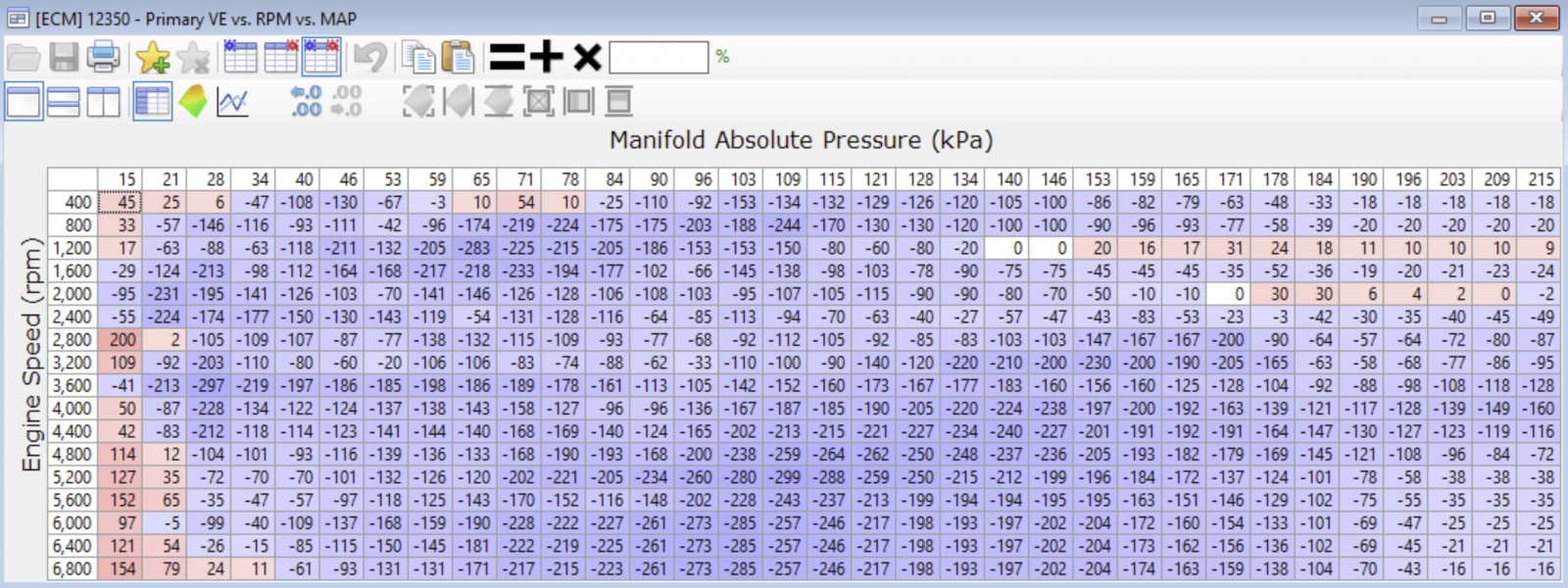
I think I will retest it with the test deactivated. Might be a problem, because the MAF Sensor in my tune reads different values in compare to the MAF Sensor in the Cobalt? I have this 3in aluminum Pipe. What is the stock diameter in the Cobalt?
I checked Rockauto, the parts numbers for the LAP and LSJ MAF Sensor are the same and the sensor is in the same orientation as it was at the LAP. But I don't know if that orientation is correct. All I know is, I didn't changed it.
This is the difference between the LSJ stage 2 standard tune and the tune I have.
This is the VE Table
I think I will retest it with the test deactivated. Might be a problem, because the MAF Sensor in my tune reads different values in compare to the MAF Sensor in the Cobalt? I have this 3in aluminum Pipe. What is the stock diameter in the Cobalt?
I checked Rockauto, the parts numbers for the LAP and LSJ MAF Sensor are the same and the sensor is in the same orientation as it was at the LAP. But I don't know if that orientation is correct. All I know is, I didn't changed it.
- mike_sno Goblin Guru
Max timing reduction:
- You have a VERY large amount of Knock retard. I would look at a number of physical and tune reasons for it before too many WOT pulls. It may be true or false knock, but it is pulling tremendous amounts of timing out. See chart below.
View attachment 44918
I looked in this table as well. This is way better when I have the LSJ Stage 2 tune. I wonder why I have so much knock under 3000rpm. However, the picture below is from the short log where I did not really do a WOT from the 2000rpm range.
What are acceptable numbers in that table? Should knock retard be 0?
- mike_sno Goblin Guru
I made another drive the the LSJ Stage 2 tune and the P0068 disabled. This time I did not get the enginer power reduced error. Sadly, I am currently not trusting either tune and don't want to hit it to hard, because I am afraid I damage the engine 
Anyway, attached is the new log. It took a bit longer to start as to see in the logfile. Seems like last time it was just luck that it ran better from the first try.
Now, I am bit confused regarding the O2 Sensor. My car should have a narrow band O2 sensor. I thought that thing would be simply digital and could only tell you 0V or 1V. But in the logs I see an analog signal between 0 and 1V. 5 googles searches later and it seems my first impression of a narrow band is wrong. Narrow means AFR 14.6 to 14.8:1. (Different websites give you different values, ugh...) Does that mean 14.6=0V and 14.8=1V?
A wide band measures between AFR 10:1 and 20:1 and instead of 0 ... 1V they come in 0...5V or 0...3.3V. Now my question: I could simply create a small circuit which transforms the 0...5V to a 0...1V. Knowing that 0V would be 10:1 and 1V 20:1 would that not allow LSJ users to use a Wideband O2 Sensor and get into more close loop? It's my understanding that all this different VE, Speed density,... is only there because of the not existing good enough feedback of the O2 sensor.
It seems to me that I have knock only under 3000rpm when I push on the gas gedal. Over 3000rpm almost nothing.
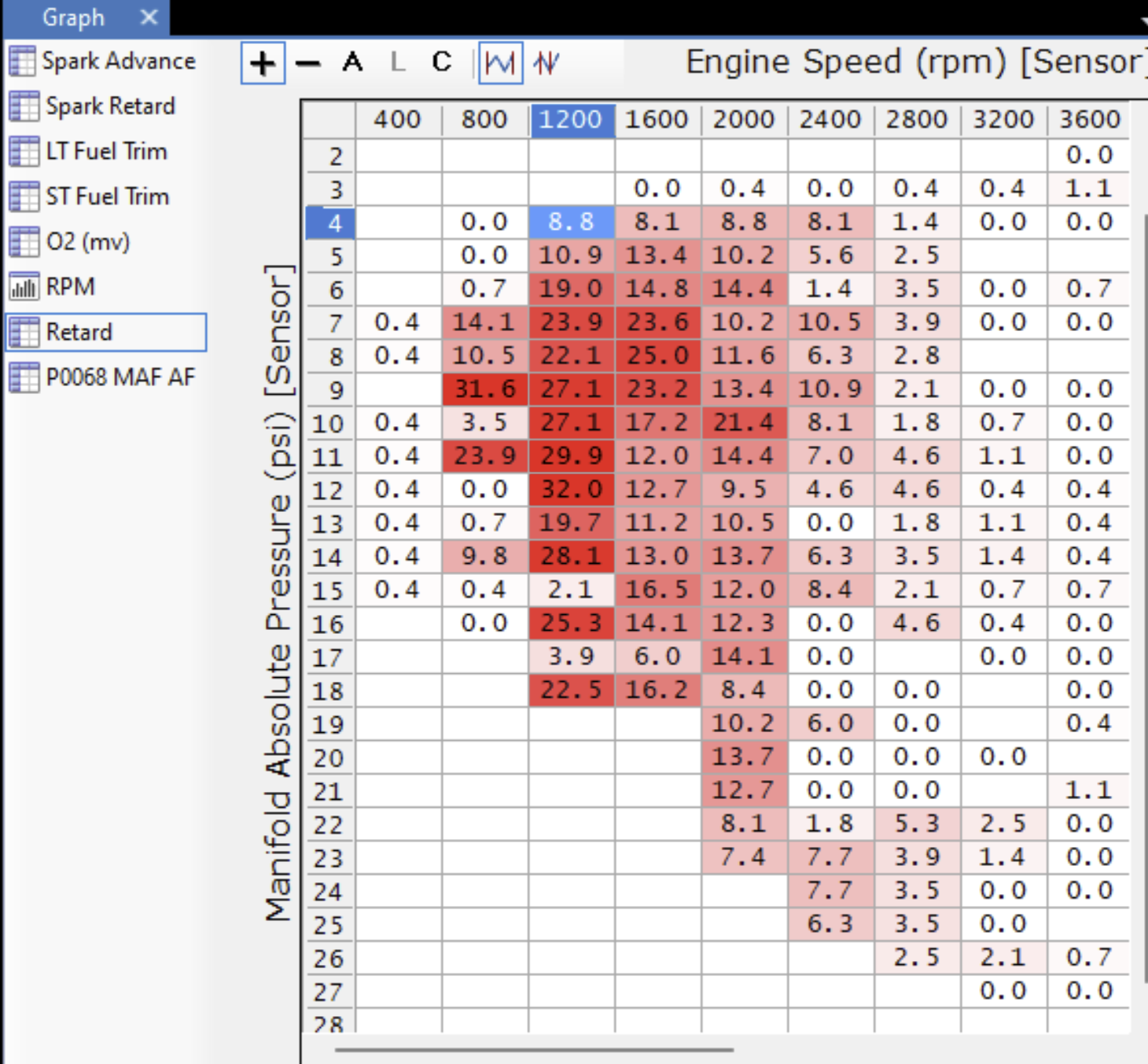
Anyway, attached is the new log. It took a bit longer to start as to see in the logfile. Seems like last time it was just luck that it ran better from the first try.
Now, I am bit confused regarding the O2 Sensor. My car should have a narrow band O2 sensor. I thought that thing would be simply digital and could only tell you 0V or 1V. But in the logs I see an analog signal between 0 and 1V. 5 googles searches later and it seems my first impression of a narrow band is wrong. Narrow means AFR 14.6 to 14.8:1. (Different websites give you different values, ugh...) Does that mean 14.6=0V and 14.8=1V?
A wide band measures between AFR 10:1 and 20:1 and instead of 0 ... 1V they come in 0...5V or 0...3.3V. Now my question: I could simply create a small circuit which transforms the 0...5V to a 0...1V. Knowing that 0V would be 10:1 and 1V 20:1 would that not allow LSJ users to use a Wideband O2 Sensor and get into more close loop? It's my understanding that all this different VE, Speed density,... is only there because of the not existing good enough feedback of the O2 sensor.
It seems to me that I have knock only under 3000rpm when I push on the gas gedal. Over 3000rpm almost nothing.
Attachments
- mike_sno Goblin Guru
I forgot to mention, I was eyeballing a bit the laptop and knock retard table while driving. And this weird oscillating of the engine, which @Robinjo fixed with the throttle pedal adapter seems to be the knock detection. I'm not 100% but I think I saw a few times that when the engine started this oscillating under 3000rpm that high numbers came in the corresponding cell.
@Robinjo are you sure it's not knock in your car?
@Robinjo are you sure it's not knock in your car?

Ross
Goblin Professor

- Ross Goblin Professor
Do you have your wideband gauge visible from the driver's seat?
Watching this gauge, and understanding what lambda the ECU/PCM is requesting, lets me know if the engine is running right, or if I am getting into danger, and could harm the engine. A laptop running VCM Scanner can show you what the ECU is requesting (commanded air/fuel ratio), and what the current lambda is.
A lambda value of 1.2 is 20% lean, which is normal if you are coasting down a hill, or from a high speed. Your ECU has stopped the injectors, and the lambda value will start rising as the exhaust starts getting oxygen.
A lambda value of 1.0 is normal if you are driving at a steady speed, the ECU is requesting stoichiometric fuel ratio.
A lambda value of 0.8 is 20% rich, which is normal if you hit the gas pedal, the ECU is requesting fuel enrichment.
The ECU uses the stock narrowband O2 sensor like a switch, either the engine is above stoich, or below. If below stoich, say .99 lambda, then it will reduce the injectors, and then it goes above stoich, say 1.01 lambda, and it increases the injectors. Normal engine is constantly going above and below stoichiometric.
VCM Suite will allow you to compare tunes, which is great when you have a stock tune, and a tune that you want to understand.
Here is a guide where Chad compares his LSJ tune against a stock tune, and explains what the changes are (the green highlighted values).
Watching this gauge, and understanding what lambda the ECU/PCM is requesting, lets me know if the engine is running right, or if I am getting into danger, and could harm the engine. A laptop running VCM Scanner can show you what the ECU is requesting (commanded air/fuel ratio), and what the current lambda is.
A lambda value of 1.2 is 20% lean, which is normal if you are coasting down a hill, or from a high speed. Your ECU has stopped the injectors, and the lambda value will start rising as the exhaust starts getting oxygen.
A lambda value of 1.0 is normal if you are driving at a steady speed, the ECU is requesting stoichiometric fuel ratio.
A lambda value of 0.8 is 20% rich, which is normal if you hit the gas pedal, the ECU is requesting fuel enrichment.
The ECU uses the stock narrowband O2 sensor like a switch, either the engine is above stoich, or below. If below stoich, say .99 lambda, then it will reduce the injectors, and then it goes above stoich, say 1.01 lambda, and it increases the injectors. Normal engine is constantly going above and below stoichiometric.
VCM Suite will allow you to compare tunes, which is great when you have a stock tune, and a tune that you want to understand.
Here is a guide where Chad compares his LSJ tune against a stock tune, and explains what the changes are (the green highlighted values).
Similar threads

- Replies
- 0
- Views
- 1K

- Replies
- 168
- Views
- 19K

- Replies
- 2
- Views
- 2K