
-
We've upgraded and reskinned the forum. Notice something off? Email us at [email protected] and we'll fix it.
You are using an out of date browser. It may not display this or other websites correctly.
You should upgrade or use an alternative browser.
You should upgrade or use an alternative browser.
V1 Blue Man's City Goblin - 05 Base Donor

Desert Sasqwatch
Bigfoot Goblin

- Desert Sasqwatch Bigfoot Goblin
Hmm, so my asking if the fuel pump was jumped in the fuse box and stating its possible that a problem could occur is fear mongering...sounds like this possibility needs to be looked into.
If power is at the fusebox, all fuses and all connections are good, then power out of the fusebox needs to be tested to the items failing to function.
If power is at the fusebox, all fuses and all connections are good, then power out of the fusebox needs to be tested to the items failing to function.

Blue Man
Well-Known Member

- Blue Man Well-Known Member
The pump was running even though the engine didn’t turn over, so maybe it’s okay?
In reading the posts above, I wonder if our engine has a ground? The mounts are powder coated, so where would the engine ground too? Do I need to get a ground established?
we followed the old wiring videos for the automatic so a bunch of our grounds are in the tunnel. Could I just run a wire from one of the empty screws (stuff we took off) to the grounding post on the car by the fuse box? Would that help? Does it need to be a thick wire?
In reading the posts above, I wonder if our engine has a ground? The mounts are powder coated, so where would the engine ground too? Do I need to get a ground established?
we followed the old wiring videos for the automatic so a bunch of our grounds are in the tunnel. Could I just run a wire from one of the empty screws (stuff we took off) to the grounding post on the car by the fuse box? Would that help? Does it need to be a thick wire?

Ross
Goblin Professor

- Ross Goblin Professor
The Cobalt engine has a ground strap. The Goblin uses solid metal engine mounts, so if those bolts allow ground, then a strap isn't needed... but it would help if the engine mounts are not conducting. The strap could go to any bolt on the block, but since the starter motor uses the most amperage, I would pick a starter mounting bolt, and run that to the frame ground bolt under the fusebox.
Desert Sasqwatch
Bigfoot Goblin
- Desert Sasqwatch Bigfoot Goblin
Or you could could get one if you cannot locate it. One like this would work.

Rttoys
Smokin' Goblin

- Rttoys Smokin' Goblin
the engine will get its ground from mounting to the frame, but it’s considered a dirty ground due to powder coat and such. A good ground wire from engine to frame or the subframe (or both) makes a solid ground. As Ross said, the stock one is short black wire with 2 lit’s or add any thick wire from frame to engine.
KingChuck24
Well-Known Member
- KingChuck24 Well-Known Member
As others have said it could possibly be your engine to frame ground wire, I had forgotten to attach mine and it took me about a week of troubleshooting before I realized that I did not have it on. I also had that same click when trying to turn over the engine but mine would keep on clicking so it might not be the exact same issue. Still, you should certainly attach the engine to frame ground wire.
Blue Man
Well-Known Member
- Blue Man Well-Known Member
Thanks to everyone for help with this issue.
Part of the fun was that our donor was sitting in a field for 18 months before we bought it. (The price was right). The previous owner said that it was a reliable daily driver until they hit a deer on the freeway, crashed off the road and bent the frame and did other damage. Anyway, we've never seen the engine run,...
I went and bought an engine ground strap and attached it from an empty screw post on the engine (used to hold EVAP or fuel line or something) to the frame ground screw by the fuse box.
I also removed the starter and bench tested it (worked perfectly) and hand turned the engine to make sure it wasn't seized. (It turned just fine)
We attached the O2 sensor (just in case) and put the MAF on (just in case?)
Then we went through all the fuses and they were all fine. We made sure all the ground bolts were tightened and then we reattached the battery.
In the ACC position the carburetor valve responded again and we could hear the fuel pump prime. We crossed our fingers and tried to turn it over.
It coughed and wheezed and ran for a few moments and died. Not bad for the first start in over two years, I think.
So we tried it a few more times and it would run, but really fitfully and it wouldn't idle.
It would appear that failure to ground the engine was the reason it would not turn over and start. Now the goal is to make it run properly.
A few questions:
1. The fan never turned on and I do not think the connection for temperature is attached anywhere. Where does that attach and am I going to destroy the engine without it plugged in? I'd like to hear that fan running.
2. How do I know that the coolant is moving through the system? I don't want to burn things up (checked the oil, the oil level is good. The oil is at least 2+ years old, so I probably ought to change it soon, but I wanted to see the engine run first.)
3. After a few times of running it it wouldn't turn over again. But the odometer reading was saying "engine performance reduced . . . engine immobilized" Anyone heard of that and what does that mean? Gave it a few minutes and then it started again.
4. Where to go from here? The engine starts, just needs some tuning or something and I need to be sure the accessory systems are running.
I figure I will attach and OBD reader and see what it says. I thought I would access the spark plugs and see how they look. Would a dead spark plug cause the engine to run very rough and backfire on occasion?
Anyway, very happy with the success of the engine starting but now trying to figure out how to make it idle properly.
I would love and appreciate some more wisdom from the forum.
Thanks!!!
Part of the fun was that our donor was sitting in a field for 18 months before we bought it. (The price was right). The previous owner said that it was a reliable daily driver until they hit a deer on the freeway, crashed off the road and bent the frame and did other damage. Anyway, we've never seen the engine run,...
I went and bought an engine ground strap and attached it from an empty screw post on the engine (used to hold EVAP or fuel line or something) to the frame ground screw by the fuse box.
I also removed the starter and bench tested it (worked perfectly) and hand turned the engine to make sure it wasn't seized. (It turned just fine)
We attached the O2 sensor (just in case) and put the MAF on (just in case?)
Then we went through all the fuses and they were all fine. We made sure all the ground bolts were tightened and then we reattached the battery.
In the ACC position the carburetor valve responded again and we could hear the fuel pump prime. We crossed our fingers and tried to turn it over.
It coughed and wheezed and ran for a few moments and died. Not bad for the first start in over two years, I think.
So we tried it a few more times and it would run, but really fitfully and it wouldn't idle.
It would appear that failure to ground the engine was the reason it would not turn over and start. Now the goal is to make it run properly.
A few questions:
1. The fan never turned on and I do not think the connection for temperature is attached anywhere. Where does that attach and am I going to destroy the engine without it plugged in? I'd like to hear that fan running.
2. How do I know that the coolant is moving through the system? I don't want to burn things up (checked the oil, the oil level is good. The oil is at least 2+ years old, so I probably ought to change it soon, but I wanted to see the engine run first.)
3. After a few times of running it it wouldn't turn over again. But the odometer reading was saying "engine performance reduced . . . engine immobilized" Anyone heard of that and what does that mean? Gave it a few minutes and then it started again.
4. Where to go from here? The engine starts, just needs some tuning or something and I need to be sure the accessory systems are running.
I figure I will attach and OBD reader and see what it says. I thought I would access the spark plugs and see how they look. Would a dead spark plug cause the engine to run very rough and backfire on occasion?
Anyway, very happy with the success of the engine starting but now trying to figure out how to make it idle properly.
I would love and appreciate some more wisdom from the forum.
Thanks!!!
Ross
Goblin Professor
- Ross Goblin Professor
Congrats!
The OBDii reader is a good place to start. Let's see what codes the PCM is throwing.
Feel the radiator hoses, see if they are getting hot. If they are hot, the coolant is flowing.
My radiator fan was set by Chevy to turn on at 223F, which I have never got the goblin that hot. I did reprogram it with HP Tuners to a lower number, so that it does turn on, but most drives, it never needs to turn on. Only autocross, or if I leave it idling on a hot summer day.
The OBDii reader is a good place to start. Let's see what codes the PCM is throwing.
Feel the radiator hoses, see if they are getting hot. If they are hot, the coolant is flowing.
My radiator fan was set by Chevy to turn on at 223F, which I have never got the goblin that hot. I did reprogram it with HP Tuners to a lower number, so that it does turn on, but most drives, it never needs to turn on. Only autocross, or if I leave it idling on a hot summer day.
Blue Man
Well-Known Member
- Blue Man Well-Known Member
Should I have both o2 sensors connected? I do but if I have read correctly, one is supposed to be before the catalytic converter and one after.
both sensors are “before” since there’s no converter, right? So is the second sensor looking for something that is not there?
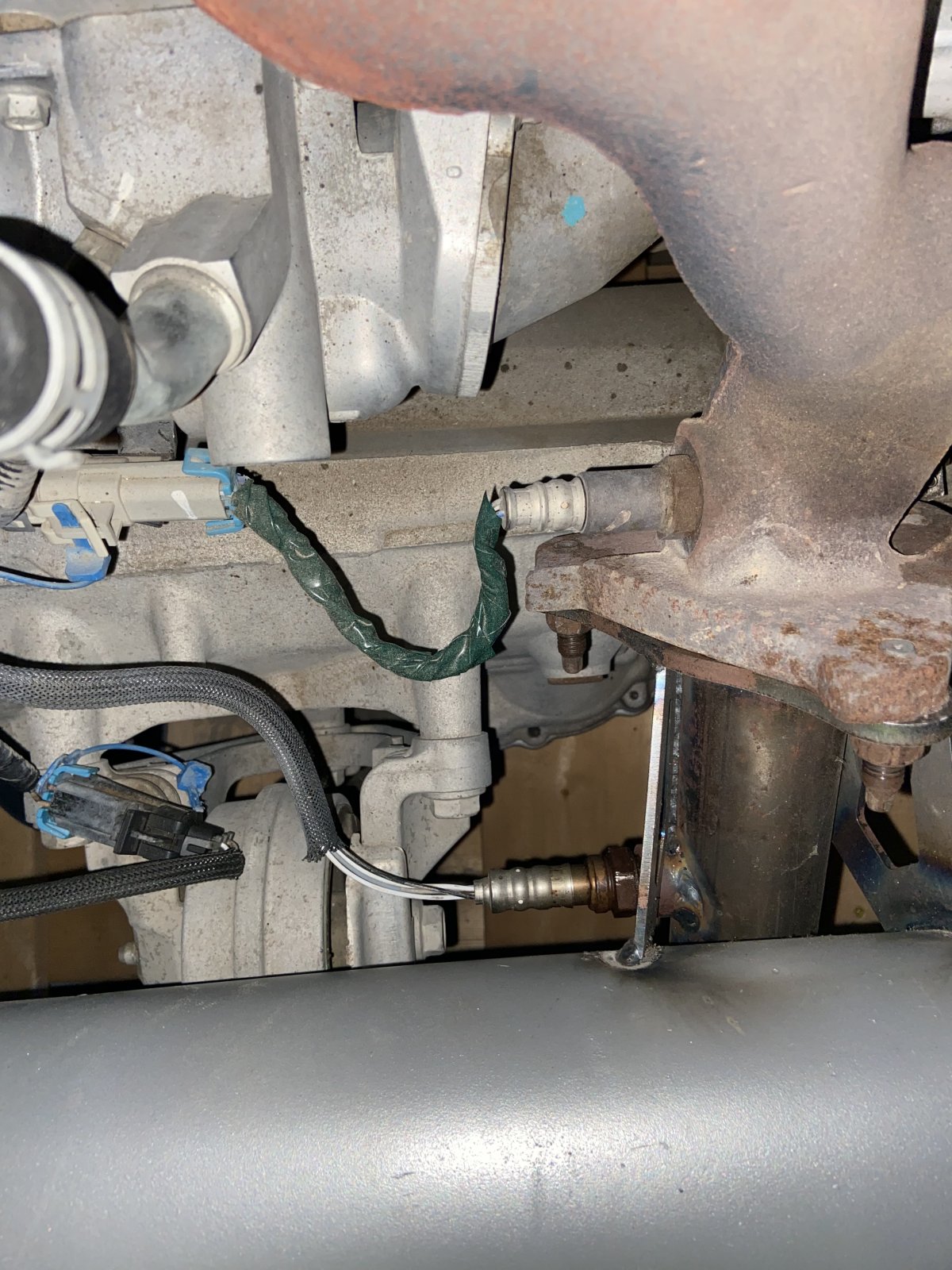
And with mine, if I don’t have both sensors I have an open hole in the exhaust.
anyone have an answer fornthis
both sensors are “before” since there’s no converter, right? So is the second sensor looking for something that is not there?
And with mine, if I don’t have both sensors I have an open hole in the exhaust.
anyone have an answer fornthis
Ross
Goblin Professor
- Ross Goblin Professor
Since you are not running a catalytic converter, I would not plug in the electrical connector on the second O2 sensor. You will just use it to plug the hole. The PCM uses that O2 sensor to add fuel to the engine, and get the cataltic converter up to working temperature. We don't really need that extra fuel being put thru our engines.

Metal Mech
Well-Known Member

- Metal Mech Well-Known Member
I was eventually gonna ask this question as well. So basically your saying there is no point in running both O2 sensors. So my next question is this. Is one spot better then the other? I am guessing since they are so close and nothing in between it doesnt make a difference.Since you are not running a catalytic converter, I would not plug in the electrical connector on the second O2 sensor. You will just use it to plug the hole. The PCM uses that O2 sensor to add fuel to the engine, and get the cataltic converter up to working temperature. We don't really need that extra fuel being put thru our engines.
Blue Man
Well-Known Member
- Blue Man Well-Known Member
I was eventually gonna ask this question as well. So basically your saying there is no point in running both O2 sensors. So my next question is this. Is one spot better then the other? I am guessing since they are so close and nothing in between it doesnt make a difference.
good question. I guess if the cord reaches it wouldn’t matter which one right? But then the car was set up for the first hole so maybe there would be better? Anyone know?


Robinjo
Goblin Guru

- Robinjo Goblin Guru
Congrats!
The OBDii reader is a good place to start. Let's see what codes the PCM is throwing.
I second this. I used a cheap OBD-II dongle from Amazon and an old Android based phone to do mine. The app I use is Torque and it works pretty well. You can use it for minor troubleshooting and even have gauges monitor stuff. The paid version is like $5 or $6 and gives you a lot more features. The free version is better for reading P-code.
After I got my codes sorted out, I use the dongle and Torque app as a dash. It's hard to see the stock speedometer and tach from the drivers seat.
Oh, reason for using the Android base is that the iPhone based version dongle needs to setup it's own Wi-Fi. Since my personal phone is Apple and I didn't have a spare one, I was having to switch between Wi-Fi (car and home) whenever I was doing stuff. It was a real pain and never connected cleanly. Since we had an old spare Galaxy I opted to use it. I think it's a Galaxy 2 or 3, so you can use pretty much any old phone. One perk is it's sooo old no one wants to steal it.
Make sure the MAF is installed in the correct direction. There is an arrow pointing in the direction of flow
Not a bad suggestion to check as well. The arrow points toward the throttle body (which is the direction of flow).
Similar threads


- Replies
- 1
- Views
- 145

- Replies
- 8
- Views
- 1K

